Ipamorelin vs. Sermorelin: Pharmacokinetics, Lab Stability, and Advanced Healing Protocols

Disclaimer: The following information is for educational and informational purposes only. The peptides discussed in this article are classified as research chemicals and are strictly for Laboratory Research Use Only. They are not approved by the FDA for human consumption, diagnosis, treatment, or cure of any disease.
1. Quick Answer: Ipamorelin vs Sermorelin Summary
When comparing ipamorelin vs sermorelin, the primary difference lies in their distinct mechanisms of action. Ipamorelin is a synthetic Growth Hormone Releasing Peptide (GHRP) that mimics ghrelin to stimulate a targeted growth hormone pulse without elevating cortisol or prolactin. Conversely, Sermorelin is a Growth Hormone Releasing Hormone (GHRH) analogue that directly stimulates the pituitary gland to naturally produce more growth hormone while preserving endogenous somatostatin feedback loops.
Table of Contents
- 2. Introduction to Growth Hormone Secretagogues (GHS)
- 3. Ipamorelin Deep Dive: Mechanisms and Pharmacokinetics
- 4. Sermorelin Deep Dive: Mechanisms and Pharmacokinetics
- 5. Head-to-Head: Ipamorelin vs Sermorelin
- 6. Laboratory Data: Synthesis, Stability, and Purity (B2B Focus)
- 7. Clinical Applications: Tissue Repair, Sleep, and Longevity
- 8. Advanced Healing Protocols and Synergistic Stacking (B2C Focus)
- 9. Safety Profiles: Contraindications and Side Effects
- 10. Frequently Asked Questions
- 11. Key Takeaways
2. Introduction to Growth Hormone Secretagogues (GHS)
To fundamentally understand the biochemical divergence between these two compounds, one must first deconstruct the biological machinery they act upon: the hypothalamic-pituitary-somatotropic axis.
In human physiology, the regulation of endogenous human growth hormone (hGH) is not a static process. It is a highly dynamic, pulsatile rhythm governed by a delicate interplay of excitatory and inhibitory neuroendocrine signals. The anterior pituitary gland, specifically the somatotroph cells, acts as the manufacturing and distribution center for hGH. However, the pituitary does not act autonomously; it is strictly regulated by the hypothalamus through two primary signaling peptides:
1. Growth Hormone Releasing Hormone (GHRH): The excitatory signal. When the hypothalamus releases GHRH, it binds to specific receptors on the anterior pituitary, triggering the synthesis and secretion of hGH.
2. Somatostatin (SRIF): The inhibitory signal. Somatostatin acts as the physiological brake pedal, suppressing the release of hGH to prevent excessive systemic levels and maintain metabolic homeostasis.
In addition to this primary axis, the body utilizes a secondary excitatory pathway driven by Ghrelin, often referred to as the “hunger hormone.” Produced primarily in the gastric mucosa, ghrelin binds to the Growth Hormone Secretagogue Receptor 1a (GHSR-1a) in the pituitary and hypothalamus, providing a potent, synergistic stimulus for hGH release.
Growth Hormone Secretagogues (GHS) are exogenous compounds engineered to hijack or enhance these specific pathways. Rather than suppressing the body’s natural production by introducing synthetic hGH directly—which leads to the negative feedback loop and eventual shutdown of endogenous production—secretagogues coax the pituitary into maximizing its own output.
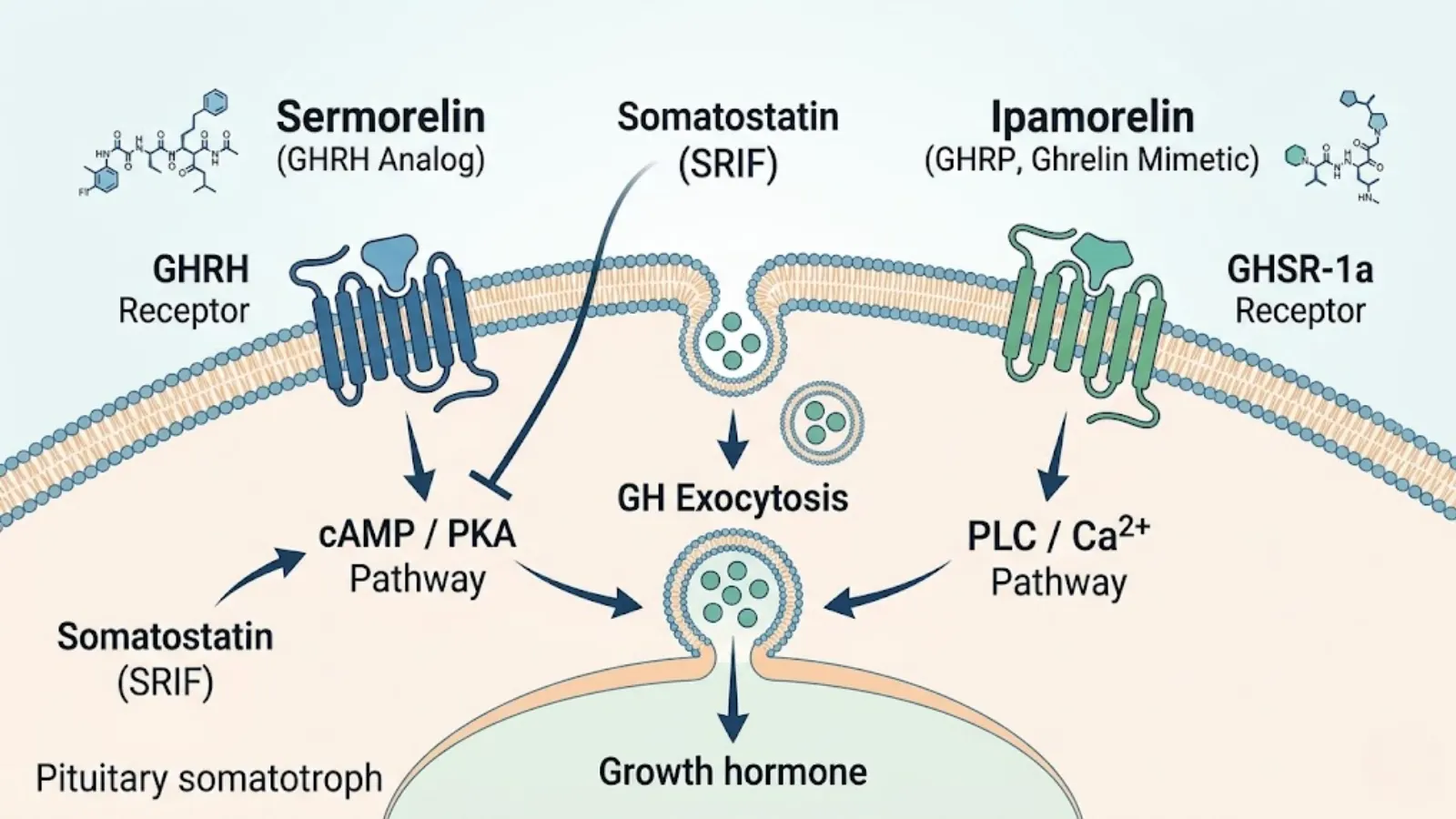
Conceptual molecular mechanism illustrating the convergent and distinct pathways of Ipamorelin and Sermorelin in the pituitary somatotroph, highlighting receptor specificity and feedback loops.
Distinguishing GHRPs from GHRHs
The field of peptide therapeutics classifies these secretagogues based on the specific receptor they target:
● GHRPs (Growth Hormone Releasing Peptides): These are ghrelin mimetics. They bypass the GHRH receptor entirely and bind to the GHSR-1a receptor. Ipamorelin belongs to this highly potent class.
● GHRHs (Growth Hormone Releasing Hormones): These are synthetic analogues of the body’s own GHRH. They bind to the GHRH receptor. Sermorelin is the foundational peptide in this category.
By understanding this dichotomy, it becomes clear why laboratory researchers and advanced biohackers strategically select one over the other—or combine them—to achieve highly specific physiological outcomes.
3. Ipamorelin Deep Dive: Mechanisms and Pharmacokinetics
Ipamorelin (Aib-His-D-2-Nal-D-Phe-Lys-NH2) is a pentapeptide, meaning it is constructed from a sequence of five amino acids. Developed in the late 1990s through a joint venture between Novo Nordisk and Helsinn Therapeutics, it was specifically engineered to be a “cleaner” alternative to first-generation GHRPs like GHRP-2 and GHRP-6.
Receptor Binding Affinity and Ghrelin Mimicry
Ipamorelin asserts its biological effect by binding exclusively to the Growth Hormone Secretagogue Receptor 1a (GHSR-1a). Once bound, it initiates a complex intracellular signaling cascade. Unlike GHRH receptors that rely on the cyclic AMP (cAMP) pathway, Ipamorelin binding triggers the phospholipase C (PLC) pathway. This leads to the generation of inositol triphosphate (IP3) and a subsequent, massive release of intracellular calcium. This sudden surge in calcium acts as the immediate catalyst for the exocytosis of secretory granules containing pre-formed growth hormone out of the somatotroph cells and into systemic circulation.
Because it mimics ghrelin, Ipamorelin induces a massive, acute pulse of growth hormone. However, unlike actual ghrelin or early-generation GHRPs, Ipamorelin is highly lipogenic-neutral, meaning it does not significantly stimulate the intense hunger (orexigenic effect) typically associated with ghrelin receptor activation.
Pharmacokinetic Profile
For clinical and research applications, the pharmacokinetics of Ipamorelin are highly favorable. Following subcutaneous administration, it exhibits a rapid onset of action, generating a robust hGH pulse that peaks within 40 to 60 minutes.
Its biological half-life is approximately 2 hours, which is remarkably long compared to natural GHRH or Sermorelin. This extended half-life means the hGH pulse it generates is sustained, allowing for a prolonged window of therapeutic action—particularly highly efficient for accelerated tissue repair, deep sleep optimization, and sustained lipolysis. The peptide is highly stable in systemic circulation before undergoing proteolytic degradation and subsequent renal clearance.
The “Clean” Secretagogue: Why It Doesn’t Spike Cortisol or Prolactin
The most significant defining characteristic of Ipamorelin—and the primary reason it dominates the advanced biohacking space—is its extreme selectivity.
First-generation peptides like GHRP-2 and GHRP-6 are notorious for their lack of specificity. While they effectively trigger growth hormone release, their receptor cross-reactivity inadvertently stimulates the secretion of Adrenocorticotropic Hormone (ACTH) and prolactin. Elevated ACTH leads to a spike in cortisol, the body’s primary stress hormone, which is highly catabolic and counterproductive to cellular repair and lean muscle accretion. Elevated prolactin can lead to water retention, gynecomastia in males, and disrupted gonadal function.
Ipamorelin was molecularly engineered to eliminate this cross-reactivity. Extensive clinical trials have demonstrated that even at supra-physiological dosages (up to 350 mcg/kg in animal models), Ipamorelin does not induce significant elevations in cortisol or prolactin. This renders it the “cleanest” GHRP available, making it the supreme choice for individuals highly sensitive to stress hormone fluctuations or those pursuing long-term, daily optimization protocols.
4. Sermorelin Deep Dive: Mechanisms and Pharmacokinetics
Sermorelin (also known as GRF 1-29) represents a completely different biochemical approach to pituitary stimulation. It is not a ghrelin mimetic; rather, it is a truncated, synthetic analogue of endogenous Growth Hormone Releasing Hormone.
Mimicking Endogenous GHRH (GRF 1-29)
Naturally occurring human GHRH is a large polypeptide consisting of 44 amino acids. However, molecular biochemists discovered early on that the entire sequence is not required for biological activity. Only the first 29 amino acids at the N-terminus are strictly necessary to successfully bind to and activate the GHRH receptor on the pituitary somatotrophs. Sermorelin is precisely this 29-amino-acid sequence.
When administered, Sermorelin binds to the GHRH receptor, activating the G-protein coupled adenylyl cyclase/cAMP/Protein Kinase A (PKA) signaling pathway. This dual-action pathway not only triggers the immediate release of stored growth hormone but, crucially, also stimulates the transcription of the hGH gene. Therefore, Sermorelin promotes both the release of existing GH and the synthesis of new GH reserves, essentially remodeling the pituitary gland’s functional capacity over time.
Endogenous Feedback Loops and Pituitary Preservation
One of the most clinically significant attributes of Sermorelin is its absolute adherence to the body’s natural somatostatin feedback loop.
When exogenous synthetic hGH is administered, the body detects the unnaturally high serum levels and reacts by flooding the system with somatostatin to shut down the pituitary’s endogenous production. Over time, this leads to pituitary atrophy.
Sermorelin prevents this entirely. Because it acts upstream as a signaling hormone, its efficacy is completely governed by somatostatin. If the body determines that GH levels are sufficient, somatostatin will block the action of Sermorelin. It is biochemically impossible to “overdose” the pituitary into exhaustion using Sermorelin alone. This safety mechanism, known as preventing tachyphylaxis, makes Sermorelin a remarkably safe compound for long-term, multi-year anti-aging and longevity protocols where the goal is to gently restore the GH axis to youthful levels (matching a 20-30 year old biological baseline).
Pharmacokinetic Profile
While its safety profile is unparalleled, Sermorelin‘s pharmacokinetics present a unique challenge. Because it is highly homologous to a naturally occurring peptide, it is extremely susceptible to rapid cleavage by dipeptidyl peptidase IV (DPP-IV) and other ubiquitous blood enzymes.
The biological half-life of Sermorelin is exceptionally short—typically between 11 to 15 minutes following subcutaneous injection. Consequently, it creates a very natural, “blunted” pulse of growth hormone that closely mimics the body’s natural episodic release, rather than the massive, sustained spike generated by a GHRP like Ipamorelin.
5. Head-to-Head: Ipamorelin vs Sermorelin
To fully leverage these compounds in clinical research or advanced biohacking protocols, one must understand how their distinct mechanisms translate to measurable physiological outcomes. Below is a granular, head-to-head analysis.
Core Comparison Matrix
| Clinical Parameter | Ipamorelin | Sermorelin (GRF 1-29) |
|---|---|---|
| Peptide Class | GHRP (Ghrelin Mimetic) | GHRH (Hormone Analogue) |
| Receptor Target | GHSR-1a | GHRH Receptor |
| Amino Acid Length | 5 (Pentapeptide) | 29 (Polypeptide) |
| Biological Half-Life | ~2 Hours (Sustained) | ~11-15 Minutes (Rapid) |
| GH Pulse Amplitude | Massive, highly sustained spike | Moderate, natural, episodic wave |
| Cortisol/Prolactin Impact | Zero cross-reactivity | Zero cross-reactivity |
| Primary Biological Action | Stimulates GH release | Stimulates GH release AND synthesis |
| Susceptibility to Somatostatin | Bypasses Somatostatin inhibition | Strongly inhibited by Somatostatin |
| Optimal Clinical Utility | Acute cellular repair, muscle growth | Long-term longevity, pituitary restoration |

Physiological targeting map contrasting the localized impact on healing and sleep (Ipamorelin) vs. holistic pituitary support (Sermorelin).
Pulsatile Release vs. Sustained Elevation
The debate of ipamorelin vs sermorelin often hinges on the desired curve of the GH pulse.
Sermorelin provides a “gentle nudge” to the pituitary. Because it is rapidly degraded and strictly limited by somatostatin, the resulting GH release is moderate and natural. It essentially restores the natural amplitude of the nocturnal GH pulse that diminishes significantly with age (somatopause).
Ipamorelin, conversely, is a chemical crowbar. Because it targets the ghrelin receptor, it effectively bypasses the somatostatin blockade. When Ipamorelin is administered, it forces a massive, sustained release of GH regardless of the body’s natural inhibitory signals. This results in a significantly higher area under the curve (AUC) for total growth hormone released per administration compared to Sermorelin.
Efficacy in Aging vs. Cellular Repair
● The Anti-Aging Argument (Sermorelin): For an older demographic focused purely on longevity, immune system restoration, and cognitive health, Sermorelin is often considered the gold standard monotherapy. It safely rehabilitates the pituitary gland without overstimulation, making it viable for continuous use over decades to maintain a youthful IGF-1 baseline.
● The Biohacking & Repair Argument (Ipamorelin): For athletes, advanced biohackers, or individuals recovering from severe musculoskeletal injuries or surgeries, the slow and steady approach of Sermorelin is often insufficient. Ipamorelin‘s ability to force a massive surge of GH translates to significantly higher acute levels of IGF-1 (Insulin-like Growth Factor 1) in the liver. This cascade rapidly accelerates collagen synthesis, bone density accretion, lipolysis (fat burning), and the repair of soft tissue (tendons, ligaments).
Cost-Effectiveness and Availability
From a B2B and wholesale perspective, manufacturing complexity drives cost. Sermorelin, being a 29-amino-acid chain, requires a significantly longer, more complex solid-phase peptide synthesis (SPPS) process, often resulting in lower yields and higher raw material costs. Ipamorelin, a simple 5-amino-acid pentapeptide, is highly efficient to synthesize at scale.
However, in the clinical and consumer market, Sermorelin has been established longer and is widely available through generic compounding pharmacies, often making the patient-facing cost somewhat comparable. Ultimately, the choice between the two is rarely dictated by economics, but rather by the exact mechanistic goal of the research or physiological intervention.
6. Laboratory Data: Synthesis, Stability, and Purity (B2B Focus)
For compounding pharmacies, principal investigators, and wholesale procurement directors, the transition from theoretical biochemistry to physical laboratory application introduces the critical variables of peptide stability, synthesis quality, and cold chain management. The structural differences between a pentapeptide (Ipamorelin) and a 29-amino-acid polypeptide (Sermorelin) fundamentally dictate how they must be handled in vitro.

Principal Investigator verifying Ipamorelin purity standards using High-Performance Liquid Chromatography (HPLC).
Lyophilization and Cold Chain Storage Parameters
Both peptides are synthesized via Solid-Phase Peptide Synthesis (SPPS) and must be supplied in a lyophilized (freeze-dried) state to prevent premature degradation. In their lyophilized powder form, these compounds are relatively stable. However, the physical structure of Sermorelin makes it inherently more fragile than the compact Ipamorelin sequence.
Sermorelin is highly susceptible to deamidation and oxidation, particularly at extreme temperatures. Therefore, strict cold chain adherence is mandatory. For long-term storage (exceeding 90 days), lyophilized vials of both peptides must be maintained at -20°C (-4°F). For short-term transit or storage under 30 days, standard refrigeration at 2°C to 8°C (36°F to 46°F) is acceptable, provided the vials are protected from UV light exposure, which can cleave the fragile peptide bonds.
HPLC Purity Standards for Research Grade Peptides
When assessing ipamorelin vs sermorelin for wholesale procurement, purity verification is paramount. Substandard synthesis often leaves behind truncated peptide sequences, trifluoroacetic acid (TFA) salts, and other synthetic impurities that can cause severe localized histaminic reactions or skew research data.
B2B buyers must demand High-Performance Liquid Chromatography (HPLC) and Mass Spectrometry (MS) assay reports from third-party analytical laboratories. A clinical-grade or research-grade standard requires a purity threshold of >99.0%. Because of Sermorelin‘s longer amino acid chain, achieving >99% purity during the cleavage and deprotection phases of synthesis is significantly more difficult and expensive, resulting in a higher likelihood of lower-purity batches hitting the grey market. Ipamorelin‘s shorter sequence yields a higher percentage of ultra-pure batches during standard SPPS protocols.
Reconstitution Variables and Bacteriostatic Water
Once a peptide is reconstituted from its lyophilized state into an aqueous solution, its biological clock begins ticking rapidly. Hydrolysis—the chemical breakdown of the compound due to interaction with water—is the primary mechanism of degradation.
For optimal shelf life, reconstitution must be performed using Bacteriostatic Water containing 0.9% benzyl alcohol. The benzyl alcohol acts as an antimicrobial preservative, preventing bacterial enzymes from cleaving the peptide structure. Once reconstituted, Ipamorelin is chemically stable in a 2°C to 8°C refrigerated environment for approximately 3 to 4 weeks. Sermorelin, due to its susceptibility to enzymatic degradation, typically degrades faster, losing significant potency after 14 to 21 days in solution. Neither peptide should ever be frozen once reconstituted, as the expansion of water crystals will mechanically sheer the peptide chains, rendering the solution biologically inert.
7. Clinical Applications: Tissue Repair, Sleep, and Longevity
The physiological endpoints of Growth Hormone Secretagogues are diverse, impacting nearly every system in the body. However, the specific clinical applications often dictate whether a researcher or biohacker selects Ipamorelin or Sermorelin.
Optimization of Slow-Wave Sleep (SWS)
The architecture of human sleep is deeply intertwined with the hypothalamic-pituitary axis. The vast majority of endogenous growth hormone is secreted during Slow-Wave Sleep (SWS), also known as deep sleep, characterized by low-frequency, high-amplitude delta waves on an EEG.
Both peptides profoundly impact sleep architecture, but through different mechanisms. Sermorelin, by mimicking natural GHRH, gently entrains the circadian rhythm, often leading to a subjective improvement in sleep latency (falling asleep faster) and an objective increase in the duration of the initial delta-wave sleep cycle. Ipamorelin, however, has an acute and aggressive impact on SWS. Because it operates through the ghrelin receptor, which heavily influences the parasympathetic nervous system, Ipamorelin administration prior to bed forces a massive GH pulse that effectively “locks” the brain into deep, restorative sleep phases. For patients suffering from severe sleep fragmentation, Ipamorelin often yields superior acute clinical data.
Accelerated Cellular Recovery and Joint Healing
Growth hormone itself is not directly responsible for tissue repair; it acts as a pro-hormone. Once secreted, it travels to the liver where it stimulates the production of Insulin-like Growth Factor 1 (IGF-1). IGF-1 is the primary anabolic engine responsible for cellular proliferation, chondrocyte (cartilage) repair, and Type II collagen synthesis.
Because of its longer half-life and ability to bypass somatostatin inhibition, Ipamorelin generates a significantly higher AUC (Area Under the Curve) of growth hormone, resulting in a much larger, corresponding spike in liver IGF-1. For acute tissue repair—such as post-surgical recovery, severe tendinopathy, or muscular hypertrophy—Ipamorelin‘s pharmacokinetic profile is vastly superior to Sermorelin. Sermorelin simply cannot generate the requisite volume of IGF-1 required for aggressive, acute healing.
Body Composition and Metabolic Impacts
Elevated growth hormone levels act as a potent catalyst for lipolysis (fat breakdown) by upregulating hormone-sensitive lipase (HSL) and inhibiting lipoprotein lipase. Furthermore, GH is strongly anti-catabolic, preserving lean muscle tissue even in caloric deficits.
Both peptides will favorably alter body composition over a 3-to-6 month protocol. Sermorelin achieves this slowly, gently reversing somatopause and subtly increasing the basal metabolic rate over time. Ipamorelin, conversely, forces immediate lipogenesis and fatty acid oxidation. For individuals focusing strictly on fat loss and body recomposition, the immediate, high-amplitude pulses of Ipamorelin provide faster, more visible metabolic shifts.
8. Advanced Healing Protocols and Synergistic Stacking (B2C Focus)
In the advanced biohacking community, theoretical mechanisms are heavily subjected to real-world application. The optimal deployment of these compounds relies heavily on biological timing and synergistic combinations.
Monotherapy Dosing Schedules
When utilized as monotherapies, the timing of subcutaneous administration is critical to align with the body’s natural circadian rhythms.
● Sermorelin Protocol: Typically dosed once daily at night, roughly 30 to 60 minutes prior to sleep. The standard biohacking dosage ranges from 200mcg to 300mcg. Because its half-life is mere minutes, it must be administered on an empty stomach (fasted for at least 2 hours), as an insulin spike from carbohydrates will instantly blunt the pituitary’s response to GHRH.
● Ipamorelin Protocol: Highly versatile. For anti-aging, a single 150mcg to 250mcg dose before bed is standard. For aggressive tissue repair or lipolysis, practitioners often split the dosage into two or three 150mcg micro-doses throughout the day (e.g., morning fasted, post-workout, and pre-sleep).

Advanced medical optimization flat lay featuring synergistic peptide protocols, monitoring devices, and support materials.
Synergistic Stacking: Combining GHRPs and GHRHs
In the debate of ipamorelin vs sermorelin, advanced practitioners often conclude that the most biologically potent strategy is not choosing one over the other, but utilizing them simultaneously.
Because Ipamorelin and Sermorelin bind to completely different receptors (GHSR-1a and GHRH receptors, respectively), they do not compete for binding sites. When administered together, they exhibit a profound synergistic effect rather than an additive one.
The biochemical math is striking: If Sermorelin yields a GH pulse value of 2, and Ipamorelin yields a value of 2, administering them together does not equal 4; it often equals 10 or more. By using Sermorelin to stimulate the GHRH pathway, while simultaneously using Ipamorelin to agonize the ghrelin pathway and suppress somatostatin, the pituitary is effectively forced open from both sides. This “stacking” methodology is the absolute gold standard in regenerative medicine clinics for maximizing IGF-1 output without resorting to synthetic hGH. (Often stacked with CJC-1295 or Sermorelin to achieve a multiplying effect on the GH pulse).
Peptide Cycling and Downregulation Prevention
Receptor desensitization (downregulation) is a critical concern in peptide therapeutics. If a receptor is continuously bombarded by an agonist, the cell will internalize the receptors (via beta-arrestin recruitment), rendering the compound ineffective.
Because Sermorelin relies on natural feedback loops, downregulation is incredibly rare. It can often be run continuously for 6 to 12 months. Ipamorelin, however, overrides natural feedback. To prevent GHSR-1a desensitization, strict cycling protocols are required. The most common biohacking standard is a “5 days on, 2 days off” schedule. This brief weekend washout period allows receptor sensitivity to reset, ensuring long-term clinical efficacy.
9. Safety Profiles: Contraindications and Side Effects
While Growth Hormone Secretagogues are exponentially safer than exogenous synthetic hGH, they are biologically active compounds with distinct side effect profiles and contraindications that must be rigorously managed.
Recognizing and Managing Injection Site Reactions
The most common adverse event for both peptides is localized erythema (redness), pruritus (itching), or a small welt at the site of subcutaneous injection. This is typically a minor histaminic reaction, either to the peptide sequence itself or, more commonly, to a low-purity batch containing TFA salts.
Mitigation Strategy: Ensuring >99% purity via HPLC testing, rotating injection sites daily (abdomen, glute, lateral thigh), and injecting the compound slowly rather than aggressively.
Systemic Side Effects
Because Ipamorelin lacks cross-reactivity with the ACTH and prolactin pathways, it generally avoids the lethargy, intense hunger, and severe water retention associated with first-generation GHRPs. However, when forcing high levels of growth hormone output, the following systemic effects must be monitored:
● Insulin Resistance: Growth hormone is counter-regulatory to insulin. Chronically elevated GH can decrease insulin sensitivity, leading to elevated fasting blood glucose levels. Researchers and biohackers must routinely monitor fasting glucose and HbA1c levels.
● Carpal Tunnel Syndrome / Edema: High levels of IGF-1 can cause mild fluid retention in the extremities, sometimes putting pressure on the median nerve in the wrist. If this occurs, the dosage must be immediately titrated down.
Contraindications
Neither Ipamorelin nor Sermorelin should be utilized in the presence of active oncology. While growth hormone does not directly cause cancer, the resulting IGF-1 is a powerful cellular proliferator. If a malignancy exists, elevated IGF-1 can theoretically accelerate the growth of the oncological cells. Furthermore, individuals with severe, uncontrolled metabolic disorders (such as advanced Type II diabetes) should avoid GHS protocols due to the potential exacerbation of insulin resistance.
10. Frequently Asked Questions (Targeting GEO Long-Tail Queries)
Which peptide is better for sleep quality: ipamorelin or sermorelin?
Ipamorelin is generally superior for acute sleep quality. By agonizing the ghrelin receptor, it strongly influences the parasympathetic nervous system, locking the brain into restorative Slow-Wave Sleep (delta waves). Sermorelin improves sleep gently over time by entraining natural circadian rhythms, but lacks Ipamorelin’s immediate, heavy sedative effect.
Does ipamorelin spike cortisol or prolactin like other peptides?
No, it does not. Ipamorelin was molecularly engineered to be a highly selective pentapeptide. Unlike older GHRPs (such as GHRP-2 or GHRP-6), clinical data demonstrates that even at high dosages, Ipamorelin bypasses the ACTH pathways, ensuring zero cross-reactivity or elevation of the stress hormone cortisol or prolactin.
How do you stack ipamorelin and sermorelin together for tissue healing?
Advanced tissue healing protocols combine them to create a synergistic hGH pulse. Because they act on different receptors (GHSR-1a and GHRH), they don’t compete. A standard clinical stack involves administering 100mcg to 150mcg of each peptide simultaneously in the same syringe, typically taken fasted prior to sleep.
What is the optimal dosing schedule for sermorelin in a longevity protocol?
For long-term longevity and anti-aging, the optimal schedule for Sermorelin is once daily, administered via subcutaneous injection 30 to 60 minutes before bed. It must be taken in a fasted state (at least 2 hours post-meal) because insulin actively blunts the pituitary’s ability to respond to GHRH.
11. Key Takeaways
When navigating the complexities of the hypothalamic-pituitary axis, the distinction between ipamorelin vs sermorelin ultimately comes down to biological precision versus natural restoration.
● Mechanism is Destiny: Sermorelin (a GHRH analogue) works within the body’s natural somatostatin feedback loop to gently restore youthful baseline levels of growth hormone, making it ideal for decades-long anti-aging protocols.
● Precision and Power: Ipamorelin (a GHRP) bypasses natural limits to force a massive, sustained growth hormone pulse. Because it does not spike cortisol or prolactin, it is the safest and most effective tool for acute tissue repair, sleep optimization, and rapid body recomposition.
● The Power of Synergy: For maximizing the clinical efficacy of both compounds, they are most effective when stacked together, utilizing distinct receptor pathways to achieve an amplified release of endogenous growth hormone.
● Laboratory Strictness: Efficacy is entirely dependent on cold chain storage, proper reconstitution with bacteriostatic water, and rigorous third-party HPLC verification to ensure >99% purity.