
What Is the Difference Between Mazdutide vs. Retatrutide? Clinical Trials, Purity, & Protocols

Disclaimer: The following information is for educational and informational purposes only. The compounds discussed, including mazdutide and retatrutide, are strictly for Laboratory Research Use Only and are not approved for unprescribed human consumption. Consult a licensed medical professional before considering any metabolic interventions.
What Is the Difference Between Mazdutide vs. Retatrutide? Clinical Trials, Purity, & Protocols
The Core Difference Between Mazdutide and Retatrutide
The primary difference in the mazdutide vs retatrutide debate lies in receptor targeting. Mazdutide is a dual agonist targeting GLP-1 and glucagon (GCG) receptors, yielding up to 18.5% weight loss. Conversely, retatrutide is a triple agonist targeting GLP-1, GIP, and GCG. This triple-action mechanism drives unprecedented weight loss approaching 29% while profoundly reducing hepatic steatosis.
The landscape of metabolic endocrinology has been fundamentally restructured by the advent of poly-agonist peptides. Moving beyond the foundational single-receptor agonists like semaglutide, clinical researchers and advanced biohackers are now focused on the next generation of incretin mimetics. At the forefront of this scientific revolution is the comparison of mazdutide vs retatrutide.
To understand why these compounds are rewriting the clinical protocols for obesity, metabolic syndrome, and non-alcoholic fatty liver disease (NAFLD/MASH), we must examine them at a molecular level. This comprehensive analysis breaks down their distinct mechanisms of action, highly anticipated 2025/2026 Phase 3 clinical data, and the precise pharmacodynamics that separate dual from triple agonists.
Table of Contents
- 1. Mechanism of Action: Dual Agonists vs. Triple Agonists
- 2. Mazdutide vs Retatrutide: The Phase 3 Clinical Trial Data
- 3. Weight Loss Efficacy & Metabolic Outcomes
- 4. Laboratory Perspectives: Purity, Synthesis, and Structure (B2B Focus)
- 5. Advanced Protocols: Dosages and Titration (B2C Focus)
- 6. Breaking Through Weight Loss Plateaus
- 7. Pharmacokinetics and Half-Life Comparison
- 8. Safety Profiles and Side Effects
- 9. Future Availability, Approvals, and Wholesale Markets
- 10. Frequently Asked Questions (FAQs)
- Key Takeaways
1. Mechanism of Action: Dual Agonists vs. Triple Agonists
The human body regulates metabolic homeostasis through a complex interplay of hormones secreted by the gastrointestinal tract and the pancreas. Single agonists (targeting only the GLP-1 receptor) rely heavily on delayed gastric emptying and central nervous system (CNS) satiety signaling. However, the body is highly adaptive; prolonged caloric deficit eventually suppresses the basal metabolic rate (BMR), leading to the dreaded “weight loss plateau.”
Both mazdutide and retatrutide overcome this plateau by recruiting additional receptor targets, but they do so through distinctly different molecular architectures.
How Mazdutide Works (GLP-1 & GCGR)
Mazdutide (formerly known as LY3305677 or IBI362) is a mammalian oxyntomodulin (OXM) analog. Oxyntomodulin is a naturally occurring peptide hormone found in the gut that binds to both the GLP-1 receptor and the Glucagon receptor (GCGR). Mazdutide has been synthetically engineered with a fatty acyl chain attached via a spacer, which binds to serum albumin in the bloodstream, extending its half-life to allow for once-weekly subcutaneous dosing.
The ingenuity of mazdutide lies in its dual-action synergy: GLP-1 activation modulates the hypothalamus to suppress appetite, increases glucose-dependent insulin secretion, and slows gastric motility. Critically, GCGR Activation is the primary differentiator. Glucagon shifts its primary metabolic output toward lipid metabolism when paired with GLP-1. It directly stimulates hormone-sensitive lipase (HSL) in adipose tissue, driving the breakdown of stored triglycerides. Furthermore, GCGR agonism increases thermogenesis in brown adipose tissue (BAT) and raises energy expenditure.
By simultaneously suppressing caloric intake (GLP-1) and forcefully increasing caloric expenditure (GCGR), mazdutide creates a profound metabolic sink, preventing the BMR downregulation that plagues traditional dieting.
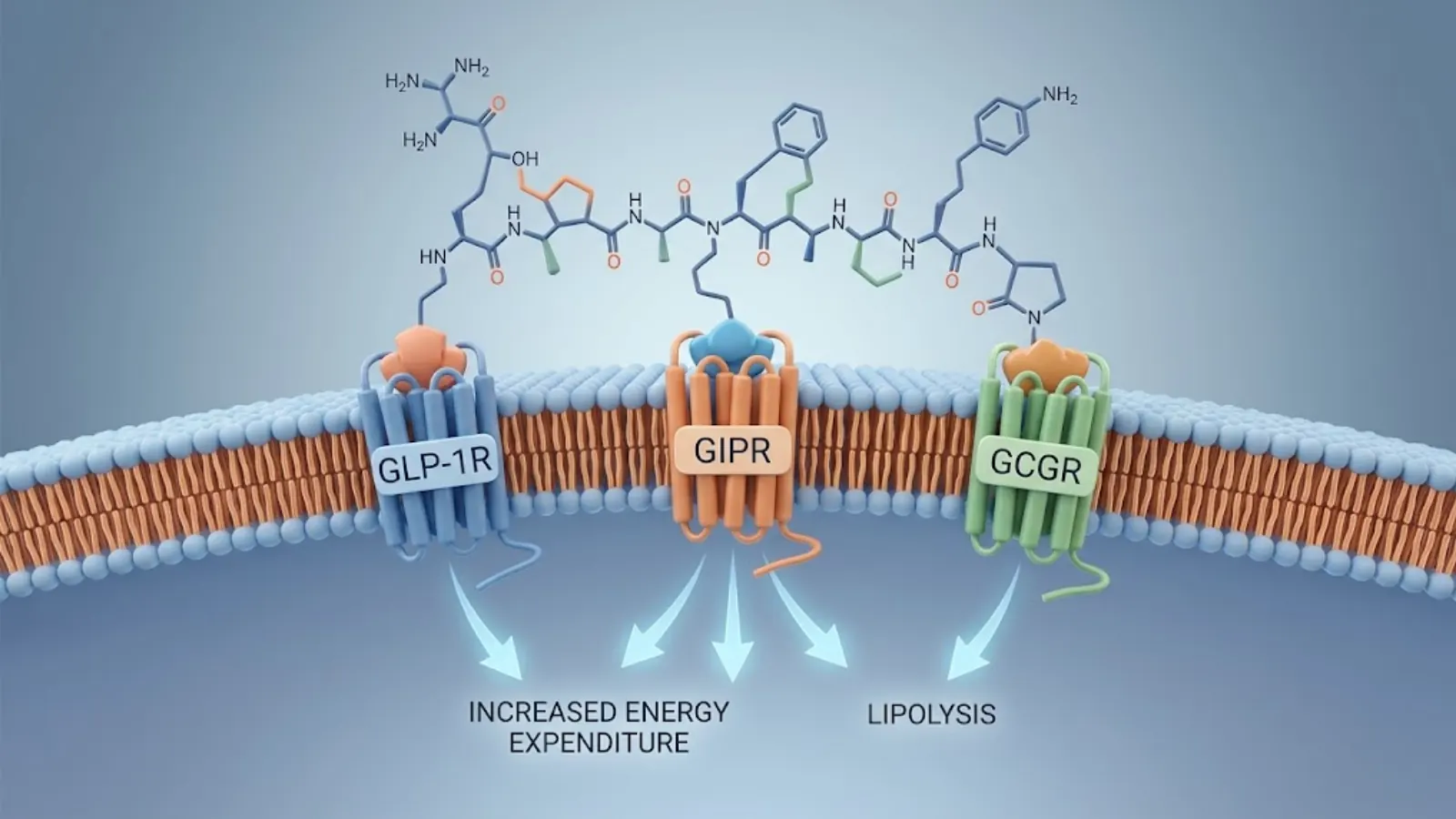
Visualizing the distinct molecular mechanisms. Mazdutide targets GLP-1 and Glucagon receptors, while Retatrutide utilizes a novel triple-action pathway targeting GLP-1, GIP, and Glucagon receptors concurrently.
How Retatrutide Works (GLP-1, GIP, & GCGR)
Retatrutide (LY3437943) represents a monumental leap in peptide engineering. Developed by Eli Lilly, it is a single-molecule “triple agonist” targeting three distinct receptors: GLP-1, Glucagon (GCGR), and Glucose-Dependent Insulinotropic Polypeptide (GIP).
If GCGR increases energy expenditure, why add GIP? The inclusion of GIP is a masterstroke designed to solve the primary limitation of dual GLP-1/Glucagon agonists: tolerability. GIP receptor activation acts as a powerful anti-emetic buffer, modulating the emetic centers in the brainstem to effectively counteract the nausea induced by GLP-1 and GCGR. This allows for higher, more effective dosing. Furthermore, GIP provides synergistic insulin sensitization, driving glucose-dependent insulin secretion and aggressively promoting lipid buffering in subcutaneous white adipose tissue.
The “Triple G” Effect: Retatrutide combines the appetite suppression of GLP-1, the potent lipolysis and thermogenesis of Glucagon, and the tolerability and insulin-sensitizing properties of GIP. The synergistic cross-talk between these three intracellular cascades results in metabolic outcomes previously thought impossible without bariatric surgery.
2. Mazdutide vs Retatrutide: The Phase 3 Clinical Trial Data
As we analyze the clinical landscape in 2026, the data moving these peptides through regulatory pipelines is robust. For researchers attempting to understand the efficacy ceiling of the mazdutide vs retatrutide paradigm, the late-stage trial data provides definitive answers.
Mazdutide Phase 3 Trials (GLORY & DREAMS)
Innovent Biologics, in partnership with Eli Lilly, advanced mazdutide primarily through the Chinese regulatory system (NMPA). The GLORY-2 Phase 3 trial was designed to test the high-dose (9 mg) efficacy of mazdutide in Chinese adults with obesity. At 60 weeks, participants receiving the 9 mg dose achieved an astonishing 18.55% reduction in baseline body weight.
In the DREAMS-3 trial focusing on Type 2 Diabetes, mazdutide demonstrated clear superiority over active comparators (like dulaglutide) in HbA1c reduction. The dual agonism ensures that even while glucagon is actively mobilizing stored energy, the GLP-1 component maintains tight, safe glycemic control.
Retatrutide Phase 3 Trials (TRIUMPH-4)
The TRIUMPH clinical program is arguably the most closely watched set of trials in the history of endocrinology. Assessing retatrutide across varied populations, the data released from the 68-week and up to 84-week marks has shattered previous records. At the maximum tolerated dose of 12 mg, retatrutide yielded a staggering 24.2% to 28.7% average body weight loss.
Uniquely, nearly 100% of participants on the highest doses achieved clinically meaningful weight loss (defined as >5% body weight), effectively eliminating the concept of “non-responders” in the trial cohort.
3. Weight Loss Efficacy & Metabolic Outcomes
To synthesize the clinical trial data into actionable insights, we must look at the specific physiological outcomes. While body weight percentage is the headline metric, the composition of that weight loss and the effect on visceral organs are where the true clinical value lies.
Comparative Efficacy Matrix
The table below provides a direct comparison of the primary efficacy metrics from high-dose Phase 3 data:
| Metric | Mazdutide (High Dose: 9mg) | Retatrutide (High Dose: 12mg) |
|---|---|---|
| Receptor Targets | GLP-1, Glucagon (Dual) | GLP-1, GIP, Glucagon (Triple) |
| Max Body Weight Loss | ~18.5% (at 60 weeks) | ~28.7% (at 68+ weeks) |
| Lipid Metabolism | High (Driven by GCGR) | Very High (Driven by GCGR + GIP) |
| HbA1c Reduction | Superior to single agonists | Unmatched; frequently normalizes A1c |

Laboratory scene and concept graph. Visualizing the divergence in ‘Mean % Weight Loss’ over 68 weeks. Retatrutide (triple agonist) establishes a deeper efficacy curve compared to Mazdutide (dual agonist).
Breaking Down the Body Weight Percentages
The leap from 18.5% (mazdutide) to nearly 29% (retatrutide) cannot be overstated. A 29% reduction in body mass is entirely commensurate with Roux-en-Y gastric bypass surgery. For advanced biohackers and clinical researchers analyzing the mazdutide vs retatrutide efficacy gap, the addition of GIP is clearly the biological lever that unlocks the final 10% of weight loss potential.
However, extreme weight loss induced by triple agonists necessitates highly optimized dietary protein protocols and resistance training to mitigate sarcopenia. The extreme caloric deficit induced by triple agonists makes muscle preservation a priority.
Impacts on Liver Fat (Hepatic Steatosis)
Perhaps the most miraculous outcome of the retatrutide trials is its effect on the liver. Non-Alcoholic Fatty Liver Disease (NAFLD)—recently updated to Metabolic Dysfunction-Associated Steatotic Liver Disease (MASLD)—is a global epidemic. Retatrutide completely normalized liver fat (reducing it to below 5%) in over 85% of trial participants within just 48 weeks.
Mazdutide also shows incredible promise for liver fat reduction due to the direct action of glucagon on hepatic lipid metabolism, but retatrutide currently holds the crown for MASH resolution.
4. Laboratory Perspectives: Purity, Synthesis, and Structure (B2B Focus)
For wholesale distributors, peptide synthesis laboratories, and B2B researchers, the biochemical complexity of these molecules presents unique challenges. Sourcing, handling, and verifying these compounds require rigorous analytical chemistry.
Peptide Stability and Lyophilization
Both mazdutide and retatrutide are highly complex, synthetic linear peptides that have been heavily modified from native human hormones. They rely on intricate C20 fatty acid diacid moieties positioned specifically to allow optimal binding and extended half-lives. Retatrutide, as a triple agonist, requires a specific 39-amino-acid chain to achieve stoichiometric binding to three different receptor pockets without steric hindrance.
In a laboratory setting, these peptides are supplied as a lyophilized (freeze-dried) crystalline powder. The lyophilization process is hyper-critical; if ambient moisture is not perfectly controlled, the multi-receptor binding domains can undergo rapid deamidation or hydrolysis, effectively degrading a triple agonist back into a standard, weak GLP-1 agonist.
Identifying High-Purity Research Compounds
For researchers investigating these mechanisms, absolute compound purity is non-negotiable. Sub-standard synthesis often leaves behind Trifluoroacetic acid (TFA) salts or truncated peptide chains. Laboratories must demand batch-specific Certificates of Analysis (COA) utilizing both:
- HPLC (High-Performance Liquid Chromatography): To ensure the compound is >99% pure. A broad or split peak indicates synthesis errors or degradation.
- LC-MS (Liquid Chromatography-Mass Spectrometry): To verify the exact molecular weight. Mass spectrometry is the only definitive way to confirm that the complex fatty acid side chains have been successfully conjugated to the peptide backbone.
5. Advanced Protocols: Dosages and Titration (B2C Focus)
Note: The following section discusses clinical trial methodologies and theoretical applications studied in advanced biohacking communities. These compounds are strictly for research.

Advanced Medical Optimization Flat Lay. Visualizing the professional tools required for precise metabolic protocols: sterile vials, biometric tracking, and data analysis.
For the advanced biohacker or functional medicine researcher tracking the pharmacodynamics of these peptides, administration protocols dictate success. Because both compounds activate the glucagon receptor, they are inherently more stimulating than single GLP-1 agonists. Therefore, aggressive titration leads to rapid desensitization (tachyphylaxis) and severe side effects.
Mazdutide Dosing Guidelines
Based on the GLORY clinical trials, mazdutide requires a methodical step-up approach. Trials typically initiate at 1.5 mg to 3.0 mg injected subcutaneously once weekly. The dose is escalated in 1.5 mg to 3.0 mg increments every 4 weeks. While early trials showed efficacy at 6.0 mg, the most profound metabolic shifts and the 18.5% body weight loss markers were achieved at the high-end 9.0 mg weekly dose.
Retatrutide Titration Strategies
Retatrutide is arguably the most potent metabolic compound ever synthesized. Introducing a triple agonist requires extreme caution. The TRIUMPH trials utilized a 2.0 mg starting dose administered subcutaneously once weekly. The dose is escalated by 2.0 mg every 4 weeks (i.e., Month 1: 2mg; Month 2: 4mg; Month 3: 6mg). The 12 mg maximum dose is where the near 29% weight loss and total liver fat resolution occurred.
6. Breaking Through Weight Loss Plateaus
In the realm of advanced biohacking and clinical weight management, the most pervasive challenge is metabolic adaptation. When an organism is subjected to a prolonged caloric deficit—even one facilitated by highly effective single-receptor GLP-1 agonists like semaglutide—the central nervous system responds by initiating adaptive thermogenesis. It lowers the basal metabolic rate (BMR), decreases non-exercise activity thermogenesis (NEAT), and aggressively upregulates hunger hormones to defend its physiological set point. This is the anatomical mechanism behind the dreaded weight loss plateau.
Understanding how to shatter this plateau is where the mazdutide vs retatrutide conversation becomes highly actionable for practitioners and biohackers.
Upgrading from Single/Dual Agonists to Triple Agonists
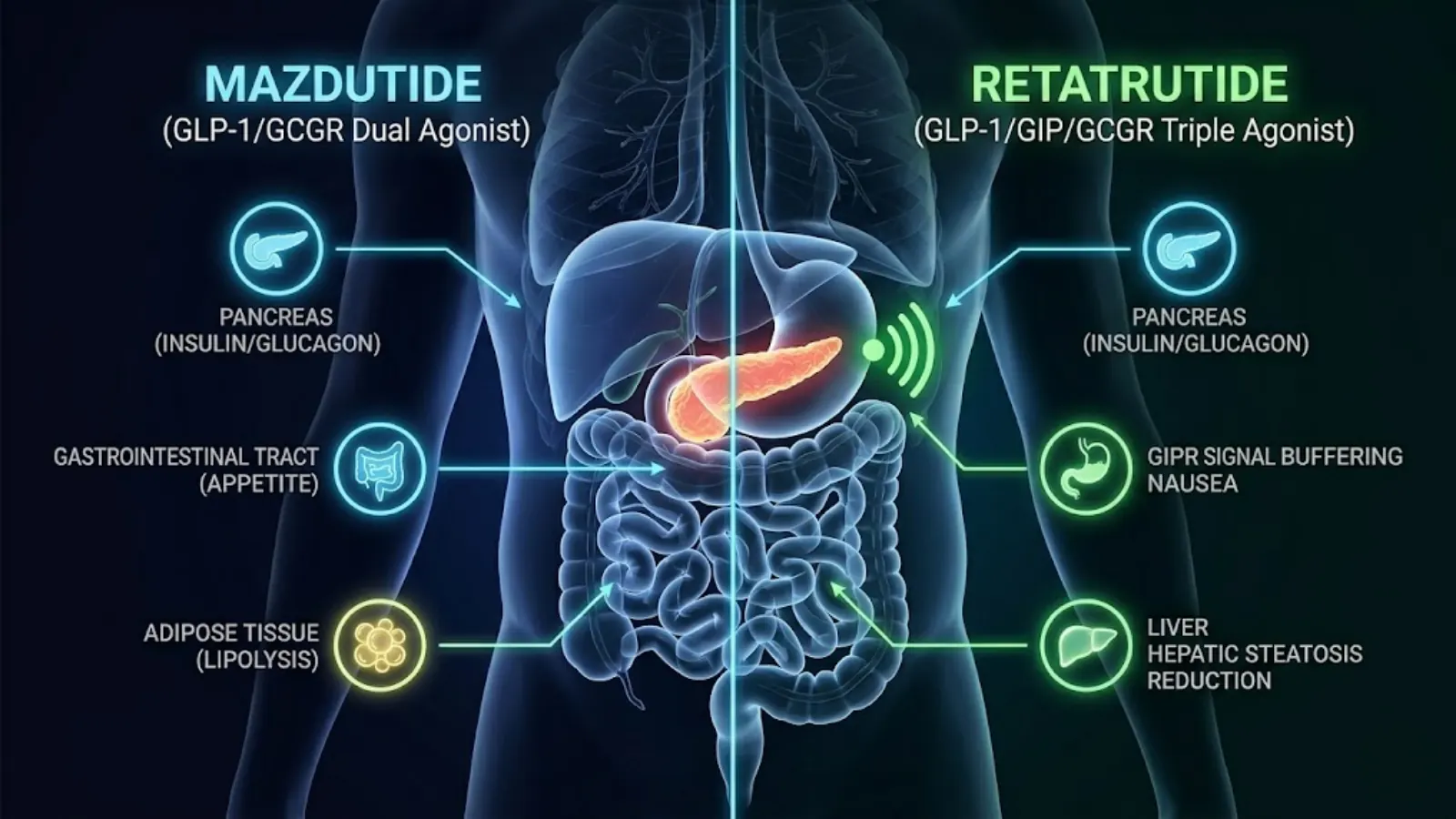
Physiological Targeting Map. Visualizing the dual-action (Mazdutide) versus the comprehensive triple-action (Retatrutide) targeting of key metabolic organs, including the stomach, liver, pancreas, and white adipose tissue.
For subjects who have “maxed out” the clinical benefits of first-generation GLP-1s or even the GLP-1/GIP dual agonist tirzepatide, upgrading to a peptide that incorporates glucagon receptor (GCGR) agonism is the next logical step. Retatrutide introduces a completely novel metabolic stimulus. The addition of GCGR agonism forcibly overrides the body’s attempt to lower the BMR, restricts incoming calories, and burn that energy as heat—a dual-pronged attack that drives weight loss past the 25% threshold.
The Role of Glucagon in Basal Metabolic Rate (BMR)
When mazdutide or retatrutide binds to the GCGR, it triggers a Protein Kinase A (PKA) cascade. PKA is the biological master switch for fat burning; it directly activates Hormone-Sensitive Lipase (HSL), violently accelerating lipolysis. Furthermore, continuous GCGR activation drives the hepatic secretion of Fibroblast Growth Factor 21 (FGF21), which enhances insulin sensitivity, promotes lipid oxidation, and ensures the BMR remains aggressively elevated.
7. Pharmacokinetics and Half-Life Comparison
For laboratory researchers managing dosing schedules, the pharmacokinetics—absorption, distribution, metabolism, and excretion (ADME)—of these engineered molecules dictate their utility.
Absorption and Bioavailability
Both mazdutide and retatrutide are administered via subcutaneous (SC) injection. The bioavailability is generally high, hovering around 80% to 85%. Due to the large size of the molecules and their respective fatty acid acyl chains, they are absorbed slowly via the lymphatic system before entering the vascular compartment. Maximum plasma concentration (Cmax) is typically reached between 24 and 72 hours post-injection.
Weekly Subcutaneous Injection Logistics and Steady-State
The critical feature of both peptides is their extended half-life, ranging roughly 6 to 8 days. This is achieved through fatty acid conjugation to human serum albumin (HSA). Albumin acts as a circulating reservoir, protecting the peptide from enzymatic degradation and immediate renal clearance. It takes roughly four to five half-lives to reach steady-state. Therefore, maximum systemic saturation and metabolic effect won’t be fully realized until week four or five, aligning with the required 4-week titration intervals.
8. Safety Profiles and Side Effects
The incredible metabolic power of poly-agonist peptides comes with a proportional side-effect profile. Objective analysis of the safety data is mandatory. While single GLP-1s are generally well-tolerated, the intense autonomic stimulation triggered by dual and triple agonists necessitates rigorous monitoring.
Managing Gastrointestinal Distress
Gastrointestinal (GI) adverse events are the most widely reported side effects. In the clinical evaluations of mazdutide vs retatrutide, the GI profile reveals a fascinating interplay. Retatrutide cleverly incorporates GIP to buffer GI effects induced by GLP-1 and GCGR. However, this buffering is not absolute. Severe GI events leading to discontinuation were noted in roughly 12% to 18% of the high-dose retatrutide cohorts, underscoring the absolute necessity of micro-titration.
Cardiac, Hemodynamic, and Neurological Safety Signals
Glucagon has a positive chronotropic effect, meaning it increases heart rate. Subjects experienced transient increases of 3 to 7 beats per minute above baseline. Fortunately, both drugs also drive beneficial reductions in systolic blood pressure. Neurologically, advanced communities are closely monitoring a side effect called *anhedonia*—a blunted ability to feel pleasure—due to the dense population of GLP-1 and GIP receptors in the brain’s reward centers. General depressive affect monitoring is recommended for long-term triple agonist use.
9. Future Availability, Approvals, and Wholesale Markets
Understanding commercial and regulatory timelines is vital for B2B distributors planning product roadmaps. As of 2026, the regulatory status represents a massive shift in global pharma dominance.
Mazdutide’s NMPA Approval in China
Based on the overwhelming success of the GLORY and DREAMS trials, mazdutide has secured pivotal approvals for both Type 2 Diabetes and chronic weight management in the Asian market. For B2B wholesalers, while mazdutide is fully commercialized in China, its global rollout in Western markets (FDA/EMA) may take longer, meaning researchers outside of Asia rely heavily on specialized peptide synthesis laboratories to procure the compound for in vitro and animal modeling.
Retatrutide’s Global FDA Timeline
Eli Lilly’s retatrutide is positioned to be the most lucrative pharmaceutical asset in history. Following TRIUMPH Phase 3 completion, commercial availability under a brand name likely hitting Western pharmacies by late 2026 or early 2027. raw active pharmaceutical ingredient (API) remains heavily restricted; high-end research laboratories are utilizing advanced SPPS techniques to synthesize retatrutide for laboratory evaluation.
10. Frequently Asked Questions (FAQs)
Is retatrutide more effective than mazdutide for severe obesity?
Yes. In rigorous Phase 3 clinical trials, retatrutide demonstrated significantly higher efficacy for severe obesity, achieving an average body weight reduction of up to 28.7% at the 12 mg dose. By comparison, mazdutide’s high-dose (9 mg) trials yielded a maximum average body weight loss of approximately 18.5%. The addition of the GIP receptor in retatrutide drives this superior metabolic outcome.
Can you safely stack or cycle dual and triple GLP-1 agonists?
Stacking (administering them simultaneously) dual and triple agonists is exceptionally dangerous and clinically contraindicated. The overlapping receptor activation would lead to severe, potentially fatal gastrointestinal paralysis (gastroparesis), profound hypoglycemia, and cardiovascular distress. Advanced biohacking protocols occasionally discuss *cycling*—moving from a dual agonist to a triple agonist over months to prevent receptor down-regulation—but they should never be combined concurrently.
Which peptide is better for improving insulin resistance?
Retatrutide is definitively superior for treating severe insulin resistance. The distinct advantage lies in its activation of the GIP receptor. GIP is a highly potent insulinotropic hormone that aggressively drives glucose-dependent insulin secretion and heavily sensitizes adipocytes to insulin, an effect that mazdutide (lacking GIP agonism) cannot replicate to the same degree.
Where can I buy high-purity mazdutide and retatrutide for laboratory research?
B2B laboratories and qualified researchers must source these compounds from specialized, USA-based or highly vetted international peptide synthesis companies. Reputable vendors must provide publicly accessible, batch-specific Certificates of Analysis (COAs) utilizing both HPLC for purity (ensuring >99% purity) and LC-MS for molecular weight verification to guarantee the complex fatty acid chains are intact.
Key Takeaways
- Receptor Dynamics: The fundamental difference is receptor targeting. Mazdutide is a GLP-1/GCGR dual agonist, while retatrutide is a GLP-1/GIP/GCGR triple agonist.
- Clinical Efficacy: Retatrutide offers unmatched, surgical-level weight loss (approaching 29%), while mazdutide provides highly robust weight loss (up to 18.5%).
- Organ Health: Retatrutide’s unique triple-action completely normalizes liver fat (steatosis) in over 85% of subjects, a massive breakthrough for MASLD/MASH.
- Safety and Titration: Inclusion of glucagon in both requires strict adherence to 4-week dose-escalation protocols to manage GI distress and transient heart rate elevations.
- B2B Quality Control: For laboratory research, both require verification by LC-MS to ensure structural integrity of their half-life-extending fatty acid chains.